Explore option mechanics
Use a virtual portfolio to inspect contracts, legs, expiration, order actions, collateral, assignment, and grouped positions.
Practice trading stock optionsUse the options strategy builder for user-defined underlying signals, DTE and strike rules, multiple legs, grouped exits, scheduled entries, and assignment or expiration lifecycle behavior.
Continued testing and automation: Premium/Elite. Live connection: Elite plus eligible provider/account. Check options coverage and restrictions.
Investfly keeps the option structure explicit across simulation, visual configuration, and Python strategy development.
Use a virtual portfolio to inspect contracts, legs, expiration, order actions, collateral, assignment, and grouped positions.
Practice trading stock optionsBuild cash-secured puts, covered calls, vertical spreads, iron condors, and other supported structures without coding.
Explore no-code automationUse Python for custom underlying signals while structured models handle contract selection, legs, groups, and lifecycle controls.
Explore PythonThese premium-selling and multi-leg examples are illustrative configurations, not recommendations or outcome claims.
Configure the spread once, then let your bot evaluate when to open and close it. This bull put credit spread illustrates how the decisions connect; the values shown are example inputs, not suggested trading settings.
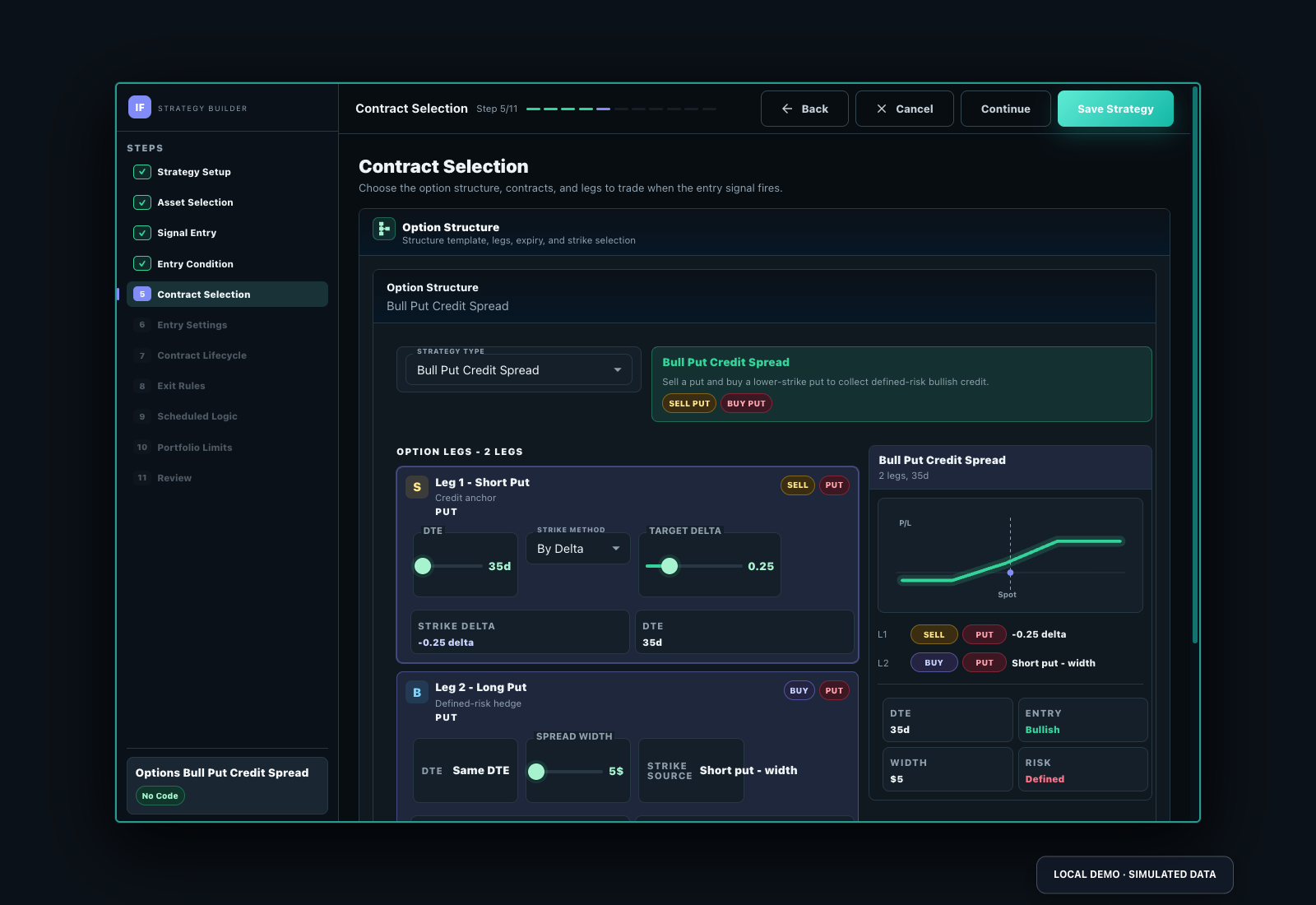
Select contracts using target days to expiration and supported expiration rules.
Describe strike selection with supported moneyness, offset, or target-delta inputs.
Treat supported multi-leg structures as a group for net premium, exits, and lifecycle activity.
Configure supported outcome rules for assignment, expiration, follow-up structures, and completion.
Option strategies currently use underlying-first signals. Historical backtests may use synthetic or proxy option pricing when full chain replay is unavailable, so results require particular care.
An options trading bot applies user-defined rules to an options workflow, including the underlying signal, structure, contract selection, entry, grouped exits, and supported expiration or assignment handling.
Supported workflows include structures such as vertical spreads and iron condors, with leg directions, DTE, strike or delta rules, grouped lifecycle controls, and eligible multi-leg order support.
You can configure supported cash-secured-put, covered-call, schedule, contract-selection, assignment, and expiration rules around a wheel-oriented lifecycle. You choose every input; it is not an income promise or recommendation.
Options backtests may use synthetic or proxy pricing when full historical chain replay is unavailable. Treat results as hypothetical, inspect the assumptions, and use simulation before considering eligible live activity.
The public bull-call debit-spread example evaluates AAPL with five-minute EMA(10) above EMA(20) and ADX(14) above 18. It selects a 45-DTE long call near 0.60 delta, a $10 spread width and one contract group, then applies net-premium group targets/limits and a lifecycle conversion rule. Inspect every leg, cost and rule in the linked strategy.
Inspect Options Bull Call Debit Spread, use Customize to save a private draft, and review every setting before running it.
| Reported historical period | Matched closed-trade records | Last completed run |
|---|---|---|
| 2026-09-03 to 2026-10-09 | 4 | 2026-10-10 |
Historical simulation, not live performance. Partial closes may create multiple matched records. The run uses available history; its dates can change as data refreshes. Inspect costs, fills, missing data and warnings in the full report. These settings demonstrate software behavior, not a recommended strategy.
Investfly’s builder is for structure selection and automated lifecycle management, with supported previews—not a promise of every analytical feature in a standalone payoff/Greeks research tool. Tradier and TastyTrade are marketed atomic multi-leg connections; Elite, account approval and exact structure compatibility apply. Modeled backtests may use synthetic/proxy option marks, not historical option-chain replay.
Read modeled options testing and paper-options practice. Review plan limits.
| Provider for live connection | Market/account scope | Paper mode | Live mode |
|---|---|---|---|
| Tradier | Eligible contracts/structures and atomic multi-leg orders | Investfly virtual portfolio: simulated funds; no provider connection required. | Elite: separately authorize an eligible provider account. |
| TastyTrade | Eligible contracts/structures and atomic multi-leg orders | Investfly virtual portfolio: simulated funds; no provider connection required. | Elite: separately authorize an eligible provider account. |
Historical testing: Underlying history with synthetic/proxy option marks where historical chains are unavailable; not historical option-chain replay. Stored intervals are 1, 5, 15, 30 and 60 minutes and daily where data is available; inspect the reported period instead of assuming every symbol has every interval.
Plan and execution limits: Premium or Elite is required for continued automated deployment and historical testing after the trial. This market’s paper practice requires the applicable Premium/Elite entitlement after the trial; Standard’s continuing free practice is for stocks/ETFs. Provider support is not a promise that every account, country, symbol, structure or order type is eligible. Review the connection and strategy compatibility report, quote timestamp, fees and market-data rights. Investfly-managed protection and modeled fills can behave differently from native broker orders. Review current plans and testing assumptions.
Start with a supported template, choose the contract rules, and test the complete group behavior.
Options involve substantial risk, including assignment and potential loss. Examples are not investment recommendations.